
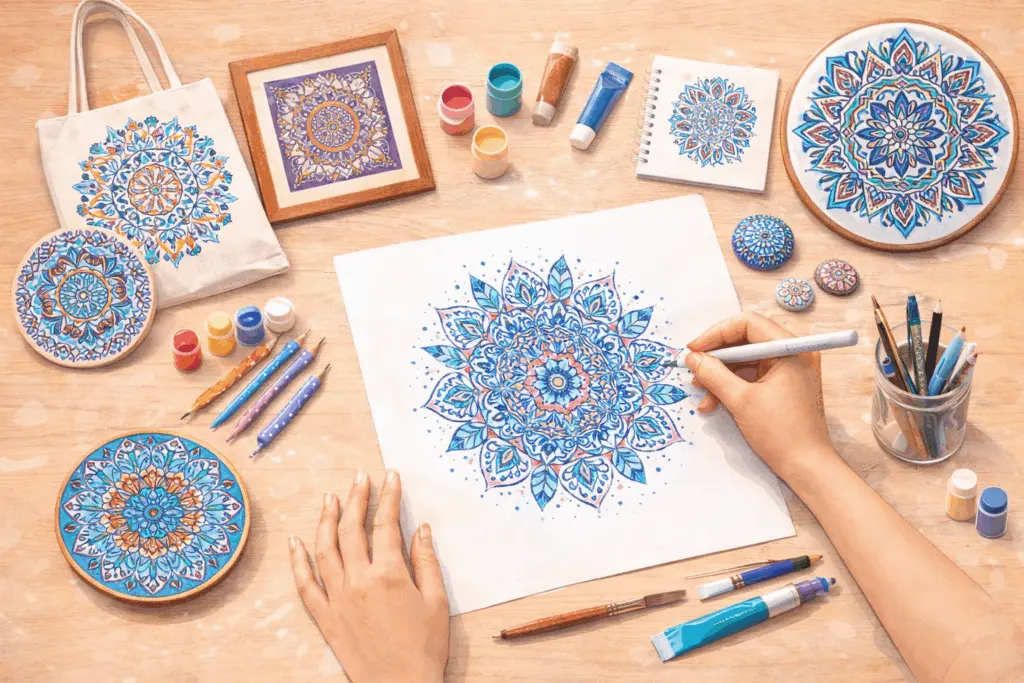
What is Mandala Art?
Mandala Art, is a geometric configuration of symbols, patterns, shapes and colors. The term ‘mandala’ comes from the ancient Sanskrit language which means “circle”, “center” or “discoid object”. It appeared during the 1st Century BCE in India. Couple of centuries later, the introduction of Buddhist religion and Mandala to other societies took place through Silk Road – from Kashmir to the Hindi Kush regions to some parts of Pakistan and Afghanistan. Mandala Art is a spiritual and religious art form which originated in India inside Buddhist monasteries, and was designed to aid in the practice of meditation. The real mandala has a centuries old visual map that represents the universe, unity, and the flow between the inner and the outer world. Its existence is in three types – Sand, Teaching, and Healing.
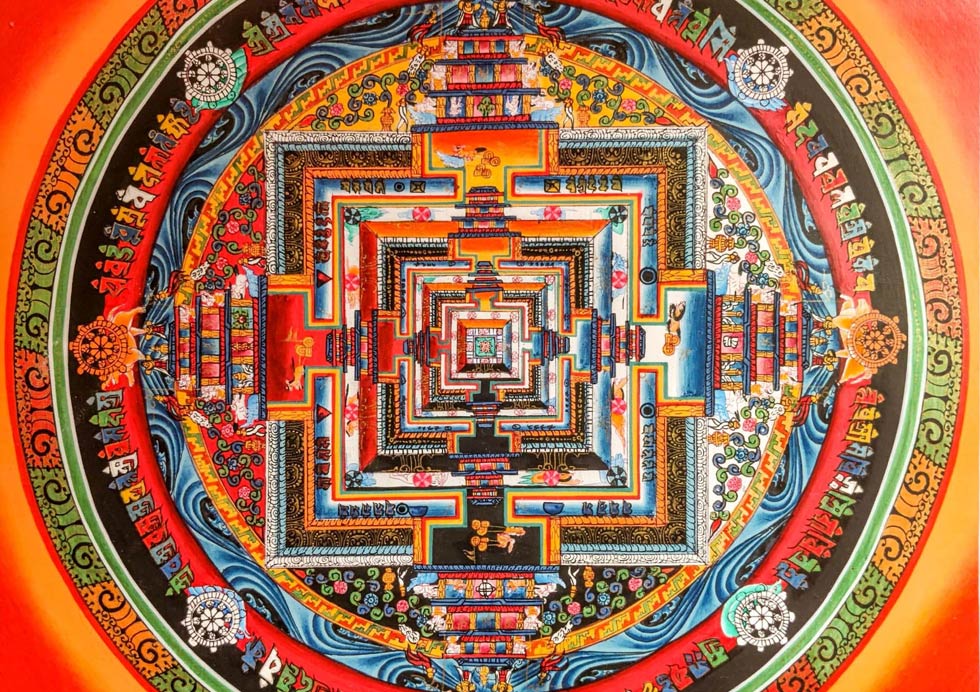
Types of Mandala Art:
Sand Mandala – is a ritual followed by Buddhist monks in which mandalas are created using beautiful colors of sand and after 7-12 days of completion, it is dismantled and ceremonially destroyed. A metal funnel tool known as ‘chak-pur’ is used to pour the sand for creation of the cosmos art. The tool is grazed with a metal rod and due to the vibrations, the sand is released on the base. This spiritual ritual and meditation put emphasis on ‘impermanence of life’ – materialistic things are temporary in nature, so is life and death.
After all the efforts, a beautiful end result is created only to be wiped away instantly, Sand Mandala represents a reminder to enjoy what you have till you have it. It puts emphasis on the impermanent nature of reality – one should embrace the present moment and learn how to enjoy the process rather than the end result.
Teaching Mandala – It is perhaps the most intellectually structured of all types. Rooted in Tibetan Buddhist practice, they are intricate symbolic maps designed to represent philosophical concepts and spiritual pathways. Each color, shape, and line within such a mandala corresponds to a specific teaching or principle, serving as a visual guide for practitioners navigating complex spiritual terrain.
Healing Mandala – It is, by contrast, is created primarily for emotional and psychological benefit rather than instructional purpose. Drawing on therapeutic traditions, healing mandalas are crafted with the intention of bringing calm, clarity, and restoration to the creator or viewer. The repetitive, symmetrical process of constructing such mandalas is believed to quiet the mind and promote a meditative state.
Yantra Mandalas originate from Hindu tradition and serve as geometric diagrams used in worship and meditation. Unlike pictorial mandalas, yantras are typically composed of precise geometric forms — triangles, circles, and lotus petals — each holding specific spiritual significance. The Sri Yantra is among the most celebrated, representing the union of divine masculine and feminine energies.
Stone and Earth Mandalas bring the art form into the natural world. These large-scale mandalas are assembled using stones, leaves, petals, and other natural materials, often created outdoors as acts of contemplation or environmental art. Land artists and nature-inspired practitioners have embraced this form as a way of forging connection with the environment.
Mandala: The modern form
As we have looked upon the traditional mandala and its types in detail, Mandalas have become a popular form of art in the modern world as well. It is widely used in interior designs, tattoos, henna designs, and so on. Drawing and coloring mandalas is also a modern form of art that requires great focus and patience which promotes mental and emotional well-being.
Tapestry mandala and dream catchers with mandala patterns have become quite trendy as these versatile pieces are known to promote harmony in the living spaces and trap nightmares or bad dreams. Modern mandala forms have also been categorized by various artists on the basis of the media used like theme (floral, animal), geometric (circle, square, triangle), colors (watercolor, gouache), illusion (3d, inverted), and dot mandalas.
Digital Mandalas represent the newest category, crafted using graphic design software and digital illustration tools. These allow for extraordinary precision, infinite color palettes, and easy replication, making mandala art accessible to a new generation of creators who work in digital spaces.
Difference Between Mandala Art and Doodle Art
Doodle and Mandala, two art forms that are distinct in intention, structure, and execution.
Mandala art is defined by its fundamental characteristic: radial symmetry. Every element within a mandala radiates outward from a central point, creating a perfectly balanced, circular composition. This symmetrical structure is not merely aesthetic — it carries philosophical significance, symbolizing wholeness, unity, and the cyclical nature of existence. The creation of a mandala typically follows an intentional, often meditative process, with the artist working in deliberate layers from the center outward.
Doodle art, on the other hand, is inherently free-form and spontaneous. Doodling emerges from an unconstrained, often unconscious act of mark-making — lines, shapes, and patterns flow organically without a predetermined plan or guiding structure. Doodles may include representational imagery such as faces, animals, or objects, alongside abstract patterns.
That said, the boundary between the two can blur in contemporary practice. Many artists blend both traditions, creating doodle-inspired mandalas that retain the circular structure while incorporating the playful freedom of doodling. Despite these overlaps, the intentional symmetry and symbolic tradition of mandala art remain its defining hallmarks.
Techniques to create Mandala: Beginners
For those just stepping into the world of mandala art, the process can feel daunting — all those perfectly symmetrical layers and intricate patterns seem to demand extraordinary skill. In truth, however, creating a mandala is an accessible, deeply rewarding practice that anyone can learn with the right approach and a bit of patience.
The first and most essential technique is establishing the foundation. Begin with a clean sheet of paper and, using a pencil and compass, draw a small circle at the very center of the page. This central point is the heart of the mandala. From this initial circle, draw a series of progressively larger concentric circles — these rings will define the layers of your design. Lightly draw straight lines radiating from the center outward, dividing the mandala into equal sections. Eight sections (every 45 degrees) are a comfortable starting point for beginners.
Once the skeleton is in place, work from the center outward. Begin by filling the innermost circle with a simple shape — a dot, a small flower, or a star. In the next ring, repeat a small pattern in each of the sections defined by your radiating lines, maintaining symmetry across all segments. The key rule is consistency: whatever you draw in one section must be mirrored in all the others.
A highly effective beginner technique is the dot-based mandala, also known as dot mandala. Using the back end of a brush, a dotting tool, or even a pencil eraser, beginners place dots of paint or ink along the geometric grid, building up layers of color and pattern. This method requires no drawing skill and produces visually stunning results, making it an ideal entry point.
Stencils and mandala templates are another valuable resource for beginners. Pre-printed templates allow individuals to focus on coloring, shading, and pattern-filling without the pressure of freehand construction. As confidence grows, these training wheels can gradually be removed.
Practicing one element at a time is a mindful approach that prevents overwhelm. Spend time perfecting a single petal shape, a leaf motif, or a geometric fill pattern before incorporating it into a full mandala. Over time, a personal vocabulary of shapes will develop, making each new mandala faster and more fluent to create.
Finally, embrace imperfection. Mandala art, particularly in its early stages, is as much about the meditative journey as the finished product. Small asymmetries are natural and, in many traditions, are considered humanizing — a deliberate imperfection that acknowledges the artist’s hand.
Tools and Material Used for Making Different Types of Mandala:
The tools and materials used in mandala art vary considerably depending on the type of mandala being created, the surface on which it is made, and the level of detail desired. Understanding the options available helps artists select the right instruments for their creative vision.
For traditional pen and ink mandalas — the most widely practiced form today — the essential tools include fine-liner pens in varying nib sizes. Brands such as Staedtler, Sakura Micron, and Rotring are favored for their consistent ink flow and precision. A set ranging from 0.05mm to 0.8mm allows for everything from the finest details to bold outlines. Compass sets and geometry tools are indispensable for constructing perfectly circular rings and evenly spaced divisions. A good quality drafting compass, ruler, and protractor form the backbone of any mandala artist’s toolkit.
For watercolor mandalas, artists use watercolor paints — either in pans or tubes — alongside round-tipped brushes of various sizes. To prevent warping, a cold pressed watercolor paper of 250gsm or above is recommended to use by the professionals. Watercolor mandalas are celebrated for their luminous, translucent quality, and artists often combine ink outlines with watercolor fills to achieve striking contrast.
Acrylic paint mandalas, particularly dot mandalas, require a different set of materials. Dotting tools — sets of metal-tipped styli in graduated sizes — are essential for creating perfectly round, uniform dots. Acrylic paints, chosen for their quick drying time and vibrant pigmentation, are applied to a variety of surfaces including canvas, wood panels, stones, and ceramic plates. The versatility of acrylics makes them a popular choice for three-dimensional mandala art.
Colored pencil and pastel mandalas, artists or professionals generally work on smooth toned paper or Bristol paper, as the layering and blending techniques help to achieve rich, velvety color. Colored pencils by Prismacolor or Faber-Castell offer a wide, finely pigmented range, while soft pastels lend a dreamy, atmospheric quality well-suited to large mandala compositions.
Sand mandala creation — the most labor-intensive form — requires colored sand or chalk powder, metal funnels called chak-pur, and an extremely steady hand. Traditional Tibetan sand mandalas use sand colored with minerals and powdered gems, though modern practitioners often use dyed sand available in craft stores.
Digital mandala artists rely on graphic tablets and styluses, often paired with software such as Adobe Illustrator, Procreate, or Clip Studio Paint. These tools offer the advantage of infinite undo, precise symmetry guides, and an unlimited color palette, enabling artists to create complex mandalas with remarkable efficiency.
In conclusion, mandala art is a living, evolving tradition that bridges the ancient and the contemporary, the spiritual and the secular. Whether carved in stone, painted in sand, inked on paper, or rendered on a digital screen, mandalas continue to captivate the human imagination with their perfect symmetry and infinite depth. For beginners and seasoned artists alike, the mandala offers a pathway into focused creativity — a circular journey that always leads back to the self.
For more info, visit our website “bellartistica“
Partnered with “Nehas Creations“
add numbering in one of the headings. 2)
